













 |
 |
 |
 |
 |

 |


    
|
 |
Next steps, and a final report!
Please download the GAMBIT Final Report here: The US instance of the Singapore-MIT GAMBIT Game Lab initiative has also recently announced the creation of the MIT Game Lab, where the staff and researchers will continue doing what they do best: combining cutting edge research with game development and rapid experimentation. More info about this can be found at the MIT News Office here: While there will no longer be any more news updates to this site, we will be updating our Read Me section with our research as it gets published and our Games and In The Press sections as our games continue to receive recognition. You can follow along with us at our new website or through our Twitter (@MITGameLab) or Facebook.
Posted by Rik Eberhardt to
News |
Permalink
7 new games to play from our Summer 2012 session!
 The games made during the Summer 2012 session of The Singapore-MIT GAMBIT Game Lab are now online! This year, we explored a diverse set of topics, and from that we created 7 games:
       You might be aware that this was the final summer of the collaboration now known as the Singapore-MIT GAMBIT Game Lab. This collaboration between the Media Development Authority and the Massachusetts Institute of Technology started way back in 2006 and has had an excellent run: 55 games, over a hundred research papers, lectures, and other publications. We've hosted dozens of visiting scholars from all over the world. We're not going away! As of October 1, 2012 the US lab (which maintained this site) will be called the MIT Game Lab -- more information will come up after our program wrap-up Symposium, "Games in Everyday Life" (which by the way, still has spots open! If you're in Boston on September 21st, come on down to see us! More details about the wrap up of the GAMBIT initiative will come out later in October. Stay tuned at this website, the new MIT Game Lab site, http://gamelab.mit.edu, and on Twitter (@MITGameLab) for more information about our future projects!
Posted by Rik Eberhardt to
News |
Permalink
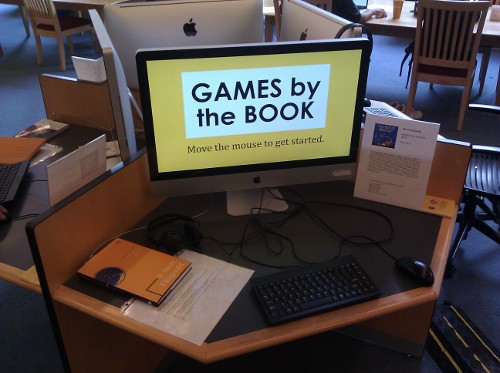
Games By The Book: Videogame Adaptations of Literary Works in at the Hayden Library
The Hayden Library is host to an interactive exhibition from September 7th. Patrons will be able to play a selection of videogames adapting literary works, from Shakespeare to Douglas Adams. The exhibit is an exploration of the range of approaches to adapting novels or plays to a videogame format, from creating worlds based on the works of a single author, to free interpretations of a novel. The result is often whimsical, turning the worlds of these stories into spaces to be explored, often abstracting them into videogame conventions. The games featured in the exhibit invite players to become Nick Carraway, the narrator of The Great Gatsby, dodging drunken partygoers in his way to meet Gatsby, explore the world of Shakespeare's plays, carry out an exercise of introspection based on Sophocles' Oedipus at Colonus, or revisit the events of The Hitchhiker's Guide to the Galaxy. Our own game, Yet One Word, is also part of the show. The games have been curated by the Clara Fernández-Vara, a member of this lab, and Nick Montfort, Associate Professor at MIT. Preparing the exhibit, both the process of curation and setting up, has been an unusual challenge, given the venue and the nature of the exhibit. Games by the Book will be open to the public until October 8th, and will be located on the second floor of the Hayden Library building. More details can be found in the exhibit's website. The exhibit is sponsored by the De Florez Fund for Humor and the MIT Council of the Arts. The organizers are the MIT Game Lab, the Electronic Literature Organization and Comparative Media Studies.
Posted by Clara Fernández-Vara to
Events |
Permalink
|
 |